
The International Hot Rod Association (IHRA) has outlined the financial framework for its 2026 Offshore National Championship Series, consisting of seven races in the United States. This setup includes a total prize fund of $2 million, marking one of the most substantial payouts in the history of offshore powerboat racing. Of that amount, $1.5 million will be distributed throughout the regular national championship events, with the remaining $500,000 held back for the season-ending World Finals (venue and exact dates have yet to be determined).
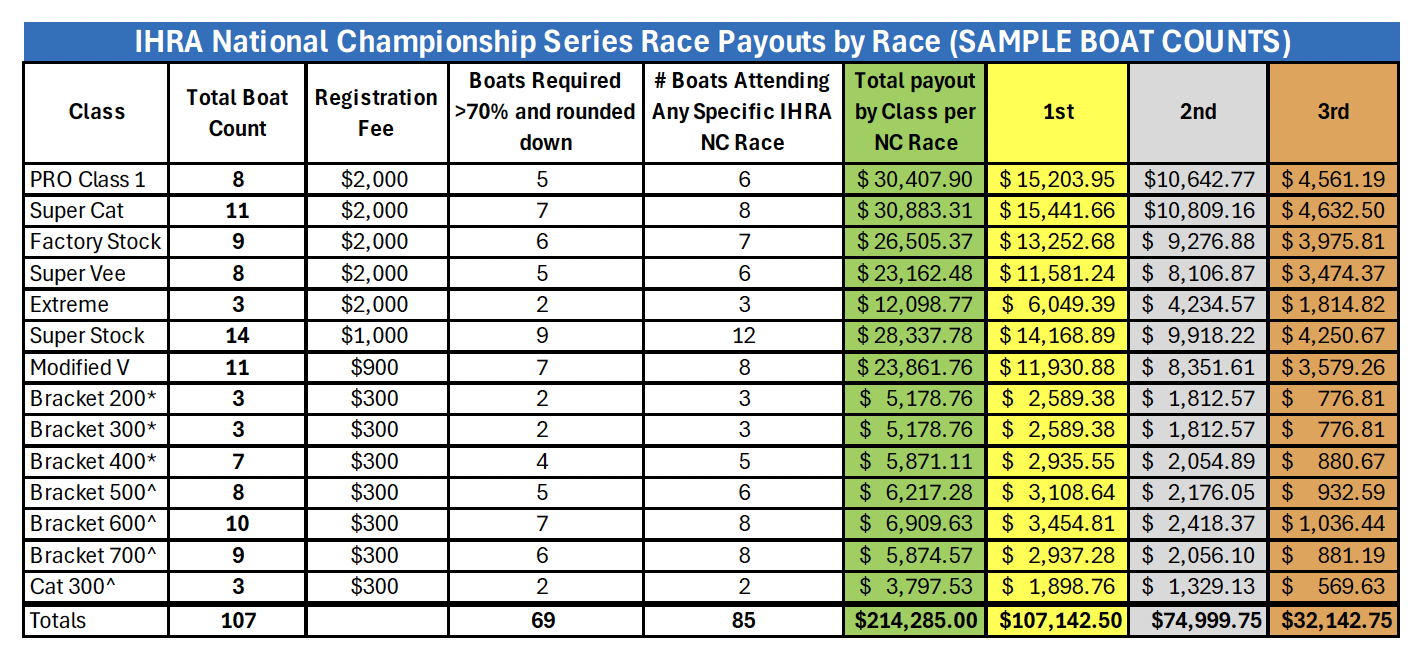
Prize payouts occur immediately following each race weekend, separate from tow money allocations, which are also disbursed at the conclusion of every event regardless of other factors. The tow money totals $650,000 across the season and supports teams with travel expenses.
The distribution of prize money varies by class and depends on several elements, primarily the number of participating boats in each category. Other considerations include registration fees paid by competitors and additional variables. Each professional and spec class operates independently for purse eligibility, though bracket classes are combined in a particular way for qualification purposes.
To unlock the purse for a given class at any race, at least 70% of the projected field (calculated by rounding down) must compete and complete at least one lap. Boat counts for these projections draw from participation levels seen at the 2025 Race World Offshore Key West World Championships, with final figures to be confirmed through discussions between IHRA and class representatives ahead of the season kickoff on March 27-29 in St. Petersburg, Florida.
IHRA powerboat president Tommy Thomassie explained the approach: "The breakdown is based on a variety of factors, but the boat count is the driving force within any given class," he told Speedboat. "The amount paid for registration is a factor. And then there's a whole host of other factors. The tow money is paid out no matter what. The purse payout, it has to be a 70% attendance by the class rounded down. Basically, each class stands on its own, with the exception of the two qualifiers on the bracket classes being grouped in a specific manner. But that's just to qualify for the purse. As long as they meet the threshold of the 70% rounded down, then the class qualifies for the purse at any given race. If they don't meet the threshold, then the purse is redistributed to everyone else. The payouts will be distributed at the end of the event, with $500,000 being reserved for World Finals."
If a class falls short of the participation requirement, its allocated prize funds roll over and are shared among the classes that achieved the mark.
This model draws inspiration from the Super Stock category, which initially proposed a similar commitment-based system. "Super Stock really came up with the basic idea," he said. "We thought, well, if they're willing to do this, why wouldn't other classes be willing to at least consider it? It could achieve the ballots that the classes in the sanctioned body/promoter needs. We're always wanting to know as far ahead of time as possible that we're going have a substantial number of the votes in each class, for a myriad of reasons. And it obviously achieves that. It also gives the classes the ability to self-regulate, self-govern, and push each other to attend. If they choose to effectively boycott or skip a race, there's implications of doing so. It's an innovative pathway to the future and not having to sit around waiting for whoever may or may not show up. We're look forward to having hopefully the biggest turnouts across the season."
The structure encourages stronger, more predictable attendance, allowing teams and organizers to plan with greater confidence while promoting accountability within the classes.
To qualify for the World Championships, teams need to participate and start a lap in at least four of the regular-season races, with additional incentives like point bonuses for extra appearances. Entry fees for events have been lowered by roughly 15% compared to previous standards.